





 Local Weather
 Weather Forecast
 Weather Warnings
 Weather for Fishermen
 Weather for Marine
 Weather for Aviation
 Weather Monitoring Imagery
 GIS Weather Service
 Tropical Cyclone
 China Weather
 World Weather
 Climate Information Service
 Warnings & Signals Database
 Statistics of Special Weather Events
 Monthly Weather Summary
 Climate Change
 El Nino and La Nina
 Earthquakes
 Tsunamis
 Tide
Tide Geomagnetism
 Space Weather
 Weather Information for Astronomical Observation
 Interactive Sun Path Diagram
 Astronomical Data
 Interesting Astronomical Phenomena
 Time Services
 Calendar
 Almanac
 Real time Radiation level in Hong Kong
 Understanding Radiation
 Radiation Monitoring, Assessment and Protection
 Environmental Radiation Monitoring Programme
 Daya Bay Contingency Plan
 Related Sites
 Schools
 Travel
 Sports
 Outdoor Photography
 CWOS
CWOS Senior Citizens
 Stargazers
 FoOb
FoOb My Little Observatory
 Interactive Map of Storm Damage by Mangkhut
 Educational Resources
 360 Tour of HKO
 Decoding Radiation
 A Tour of Tropical Cyclones
 Cloud Appreciation by Dr Tin
 International Cloud Atlas
 Guided Tour
 Courses and Activities for the Public
 Subscription of e-Bulletins
 Research Forum
 Publications
 International Atomic Energy Agency
 Regional Specialized Meteorological Centre for nowcasting
 Asian Aviation Meteorological Center
 Social Media
 Press Releases
 What's New
 HKO Updates
 LegCo Questions and Answers
 Weather Chit Chat
 Observatory's Blog
 Weather On-Air
 Cool Met Stuff
 Central Briefing
 Tropical Cyclone Report Broadcast
 Observatory's News
 Vacancies
 Tender Notices
 Apps
Apps Personalized Website
 Weather Wizard
 Weather Information in Text
 Weather Information in RSS
 Audio Web Page
 Forms
Forms Open Data
 HKO Corporate Video
 Vision and Mission
 Organizational Structure
 Quality Management
 Hong Kong Observatory – The Facts
 Hong Kong Observatory 2024
 Our Services
 Programme Areas of the Observatory
 History of the Hong Kong Observatory
 Career@HKO
 Visitors Figures
 Hong Kong Observatory Open Day 2025


What is Climatological Normal?
What is Climatological Normal?
HUI Kin-chung and LAU Ying-hong
February 2021
When reading weather reports or summaries such as the Monthly Weather Summary[1] issued by the Hong Kong Observatory (HKO), you may sometimes see the clauses like "the monthly average temperature was above normal" or "the last year's rainfall was less than normal". So, what is the meaning of "normal" in these statements?
According to the relevant guidelines of the World Meteorological Organization (WMO) in 2017[2], the standard climatological normal is derived from the observations of meteorological data calculated from the average over a 30-year period (with the ending year of "0", such as 1981-2010, 1991-2020) and should be updated every 10 years. The reason for using 30-year data is that a set of climatological normals which is stable over a longer period of time is required as a standard for climate monitoring purposes. The 30-year climatological normals can generally fulfill this requirement. If the averaging period is not long enough, some shorter-term climate phenomena, such as the influence of El Niño or La Niña, will increase the instability of the climatological normals.
Climatological normals have a wide range of uses, providing references on the recent climate for planning, design and applications in various sectors, such as agriculture, energy, engineering, water management, transportation, tourism, environment, and research. Normals are also used as references for climate monitoring and forecasting and serve as benchmarks for determining the anomaly of the current weather condition from the corresponding long-term average.
In 2021, the HKO compiled a new set of 30-year climatological normals for Hong Kong based on the meteorological data measured at the Hong Kong Observatory Headquarters and other key meteorological stations from the period of 1991-2020 to replace the previous 1981-2010 climatological normals. The comparison between the 1991-2020 and 1981-2010 normals reveals that there are statistically significant increases in the annual mean, mean maximum, and mean minimum temperatures in Hong Kong. This is commensurate with the significant long-term warming trend in Hong Kong[3] due to global warming and local urbanization. For annual rainfall and relatively humidity, the changes between these two 30-year periods are not statistically significant.
Members of the public can get access to information on the climatological normals for 1991-2020 and other previous normals at the Observatory's "Climatological Information Webpage".
Comparison of the 1991-2020 and 1981-2010 normals
*Changes are statistically significant
| Meteorological element | 1991-2020 normal |
1981-2010 normal |
Difference ("1991-2020"– "1981-2010") |
|---|---|---|---|
| Annual Mean Temperature(°C) | 23.5 | 23.3 | 0.2* |
| Annual Mean Maximum Temperature(°C) | 26.0 | 25.6 | 0.4* |
| Annual Mean Minimum Temperature(°C) | 21.6 | 21.4 | 0.2* |
| Annual Rainfall (mm) | 2,431.2 | 2,398.5 | 32.7 |
| Annual Mean Relative Humidity (%) | 78 | 78 | 0 |
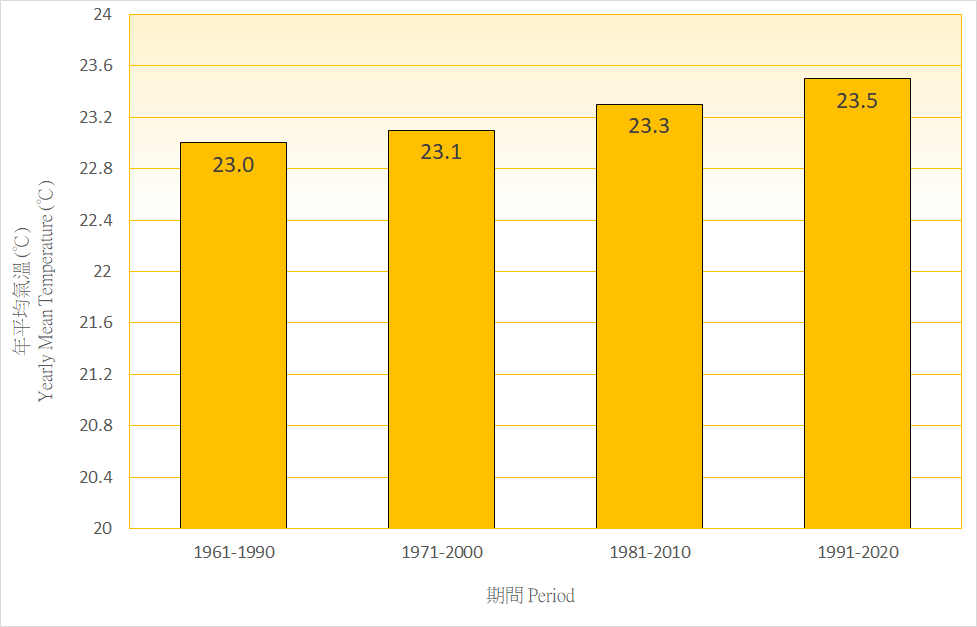
Fig. 1 1991-2020 and other three previous normals of yearly mean temperature in Hong Kong
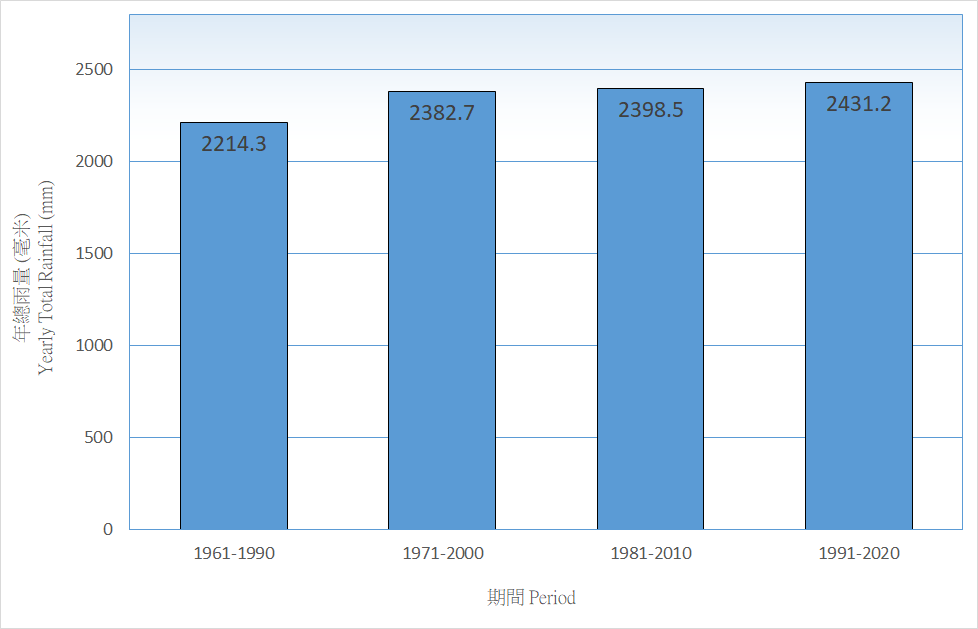
Fig. 2 1991-2020 and other three previous normals of yearly total rainfall in Hong Kong